Free Basic Seo Part 2
•Header Tags
Search engine use header tags to distinguish between the headings, sub-headings, and the general paragraph content. HTML elements (H1-H6)
are used to support this action of the search engine. The importance of header tags for the readers surpass their importance for the site
rankings. The indirect effect of header tags on site rankings involves the increased interest of readers as they make the content easy
to read and follow. The headings and sub-headings can also be used to enrich the content with keywords. Using Bookisitio to add & edit
the header tag is really simple and takes barely 1 minute. Check the tutorial.
•SEO Writing
Search Engine Optimized content writing is not a term specified for a keyword-stuffed content but a term used for a user and search engine
friendly content. The strategies used for SEO content writing is not just researching and incorporating keywords. Content production does
not solely stand for site ranking as it is for humans to read so it must be of high-quality, good length, and relevant to the site’s topic.
•Keyword Cannibalization
The concept of an increased number of pages allocated for a single keyword to rank high for that keyword is absolutely wrong.
Keyword Cannibalization is a term used for the stuffing of a keyword in multiple pages of a website. This practice is considered
harmful for SEO. Keyword cannibalization makes you compete yourself to rank for that keyword. Thus, the identification and elimination
of keyword cannibalization from your website is crucial to better your site's SEO rank.
•Content Audit
The creation of new content without auditing the old content is like moving forward leaving flaws behind. This practice will pile up
mistakes. Time to time content auditing is crucial for two purposes involving the assessment of efficiency of content in gaining its’
goals and assessment of content accuracy. Hosting outdated content on your website will eventually bring no visitors. Content auditing
also helps you focus on the type of content that is bringing the traffic. Thus, content audits help in the development and implementation
of efficient content strategy.
•Image Optimization
Visual elements make the content aesthetically attractive and also help in SEO. But bad image optimization also affects the website badly.
Proper image optimization is crucial for good website SEO. The advantages of image optimization involve, an opportunity to rank for
search engine’s image section, enhanced user experience, and enhanced page load speed. Inserting images after writing content is not a
good option. Incorporate images that are relevant to the content, add a description, and alt text for improved content rank.
•User Engagement
If you are done with an On-page SEO of the website then it does not mean that the SEO process is finished. There is a lot left after that.
What is left? It is assuring user engagement. A one-time visit is not as good as building a long-time relationship with the visitor.
It is difficult to get long-term visitors but surely achievable. To achieve this goal focus on improving the loading speed of your website
to enhance the user experience, and on writing engaging content. A point to keep in mind while doing your site’s SEO is the decreased
importance of meta keywords for the site’s rank. The claim is based
on the fact that the Google algorithm considers meta keywords less important to prevent black-hat SEO practices. Google algorithm considers
title tags and meta descriptions move important than the meta keywords. But the meta keywords are still important to attract visitors thus,
they cannot be entirely ignored. The competition demands no ignorance so, stick to every detail.
•Introduction to Hyperlink
A link that can be clicked to land on a page is called a hyperlink. The landing pages of most hyperlinks are mostly belonging to the same
website or related pages of another website. Hyperlinks also lead to pictures or downloadable resources that start downloading to the
local system after a single click. The colored or underlined or both words in an article are mostly hyperlinks. The appearance of hyperlinks
in content varies from site to site. Hyperlink consists of two parts including linked URL and anchor text. URL is the link of landing page
while the anchor text is the text in which URL is embedded.
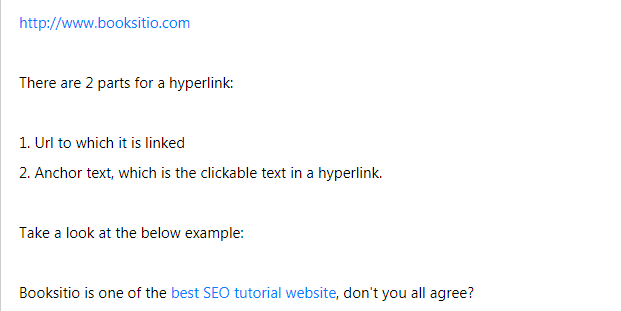
For example: among the best SEO tutorial websites one is Booksito. In this
sentence, Booksito is a hyperlink in which the words are anchor text that is linked to URL "http://www.booksito.com". Anchor texts
help search engines find out the relevancy of the linked/landing page. For example, the anchor text “SEO tutorials” let the search
engines assess that the page is related to SEO.